

Temporary lighting towers play an essential role in many rail projects, helping teams to work safely throughout the night and in other low-light conditions.
It’s key that you select the right lighting tower to suit your specific project, and its requirements.
While brightness is an important consideration, it isn’t the only factor to weigh up.
Other critical points to consider include the project’s operating hours and location, plus any specific maintenance requirements, the tower’s noise level restrictions and its level of environmental impact. All of these need to be assessed, and can determine which type of lighting tower is most suitable for your specific context.
The most common lighting tower types used today include solar, diesel and hybrid lighting towers. Each of these offers different advantages, depending on the project scenario.
In this article, we’ll provide a comparison of each of these systems, and outline the factors you need to consider before deciding the right choice for your project.
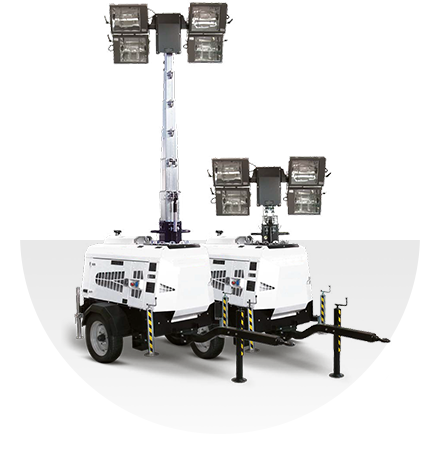
Solar lighting towers
In recent years, solar lighting towers have become increasingly popular in the rail and construction sectors. This is because they are a great solution when reducing emissions and running costs are top priorities.
Unlike diesel-powered towers, solar lighting towers generate electricity using renewable energy (which is then stored in its in-built batteries).
The key benefits of these towers include:
- Eliminates the need for regular refuelling
- Significantly reduces the amount of routine maintenance required
- Near-silent operation, as there is no engine running during normal operation (making them particularly well-suited to projects near residential areas, or during night possessions)
- Lower running costs (as there is zero fuel cost)
- Lower emissions and improved sustainability standards (compared to diesel-powered alternatives)
- Full compliance with emissions and noise targets – Under Network Rail’s sustainability push.
However, it’s important to remember that solar lighting towers rely on the natural light available, in order to recharge their batteries.
So, while modern battery systems are highly efficient (and usually able to mitigate this risk), prolonged periods of poor weather or projects that require continuous operation can experience limitations or restrictions with the amount of energy available to power the lights.
Diesel lighting towers
Diesel lighting towers continue to be widely used across the rail industry, thanks to their dependable source of power, and consistent performance in almost any conditions.
Unlike solar-powered lighting towers, diesel lighting towers don’t rely on weather conditions to charge their batteries. As long as fuel is available, they can provide consistent lighting for extended periods of time.
As a result, they are an ideal choice for projects where lighting is required throughout the night, over long durations, or for continuous operational periods.
The main benefits of diesel lighting towers include:
- Consistent, reliable operation
- No reliance on weather conditions
- High continuous power output
- Suitable for long operating hours
- Proven reliability in challenging contexts (e.g. low-sunlight winter conditions)
- No dependency on battery charge for demanding 24/7 sites.
However, the main drawbacks to consider is that diesel lighting towers require regular refuelling and servicing. They also produce engine noise and exhaust emissions during operation. So, they may not be suitable for projects in certain locations (e.g. near residential areas).
Hybrid lighting towers
For some projects, a hybrid lighting tower can offer a solid middle-ground option.
Hybrid systems combine solar battery technology with a diesel backup generator.
This effectively means that they are equipped with a safety net. Under normal conditions, the tower operates using solar energy. But, if battery levels become too low (e.g. during periods of extended poor weather), then the diesel generator automatically provides backup power.
This can be a great practical solution to the UK’s variable weather conditions, while still allowing project managers to unlock the advantages of solar-powered lighting.
Which lighting tower is best for your site?
The right choice for your project will depend on how and where the tower is going to be used.
To help you make your decision, we recommend weighing up:
- How many hours will the lighting be required each day?
- Is the site close to residential properties?
- What are the expected weather conditions?
- What level of lighting is required?
- What are your project’s sustainability targets?
- Do you need to prioritise keeping running costs down?
Assessing these factors will help you to choose the most appropriate lighting solution for both your site and project plan.
At Triptex, we supply a wide range of temporary lighting solutions, to suit all rail and industrial applications. This includes a variety of solar, diesel and hybrid lighting towers.
In fact, our Solar Lighting Tower and VT1/VT-1 Eco ranges are available to buy or hire, with 48-hour UK delivery.
So, whether you’re looking to hire or purchase lighting towers, our skilled specialists are on hand to help you find the best solution for your specific context. Speak to our team to find out more.